

Water Soluble Fertilizers: A Complete Guide for Modern Agriculture
Two growers buy the same 25 kg bag of soluble fertilizer. One runs it through a drip system for a season with no trouble. The other blocks half his emitters in three weeks and replaces the line.
The fertilizer was not the only variable. Water hardness, tank sequence, and the insolubles figure on the specification sheet all decide whether a soluble product performs or fails. Very few buying guides mention any of them.
Water soluble fertilizers dissolve completely and travel to the root or the leaf in irrigation water. They allow a grower to change the nutrient mix week by week, feed at the exact growth stage that matters, and cut the total fertilizer bill while raising the share the crop actually takes up.
This guide covers what water soluble fertilizers are, which grades exist, and how to apply them. It also covers what most articles skip: water chemistry, tank compatibility, quality specifications, and packaging.
What Are Water Soluble Fertilizers?
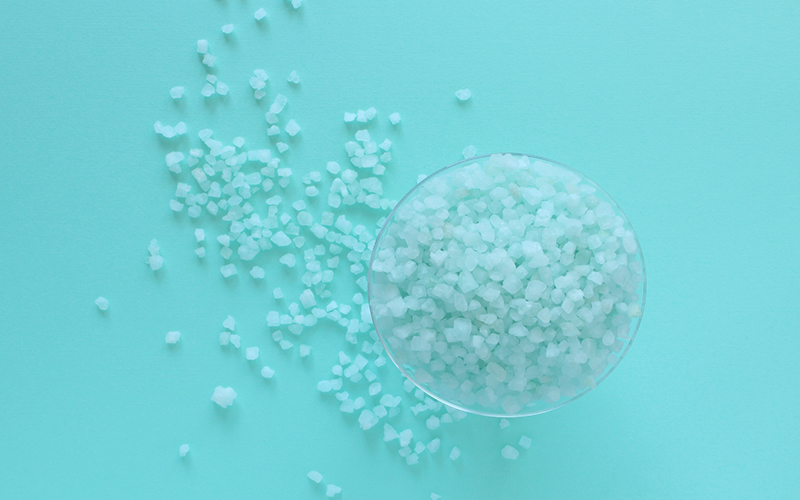
Water soluble fertilizers are crystalline or powdered fertilizers that dissolve completely in water and pass through an irrigation system without leaving residue. Growers apply them through drip lines, sprinklers, and foliar sprayers.
The category covers straight products that supply one or two nutrients, such as monopotassium phosphate or magnesium sulfate, and balanced formulations that supply nitrogen, phosphorus, potassium, and trace elements together. What unites them is purity, not nutrient content.
What Makes a Fertilizer “Fully Water Soluble”?
A fertilizer counts as fully water soluble when it dissolves at its label rate and leaves almost no solid behind. The industry measures this as water-insoluble matter, and premium grades hold it at 0.2% or below.
Two properties often get confused here. Solubility is the maximum amount that will dissolve in a given volume of water, and it varies enormously between products. Dissolution rate is how fast that happens, and it depends on crystal size, water temperature, and stirring.
Both matter in practice. A product with high solubility but slow dissolution will still clog a system if the operator mixes it too quickly. Cold water makes this worse, because most fertilizer salts dissolve more slowly below 15 °C.
This is also why conventional granular fertilizers cannot go through a drip line. Products such as DAP, urea, and muriate of potash contain fillers, coatings, or conditioning agents that never dissolve. Those particles collect in filters and emitters even when the nutrients themselves have gone into solution.
Water Soluble vs Liquid vs Granular Fertilizers
The three formats serve different operations. The table below compares them.
| Factor | Water Soluble (WSF) | Liquid Fertilizer | Conventional Granular |
| Physical form | Crystal or powder | Ready-mixed solution | Granules |
| Nutrient concentration | High, 40% to 60% | Low, 10% to 30% | High, 46% to 64% |
| Water carried in freight | None | 70% to 90% of weight | None |
| Freight per unit of nutrient | Low | Very high | Lowest |
| Mixing step before use | Required | Not required | Not applicable |
| Application methods | Drip, sprinkler, foliar, hydroponics | Drip, foliar, soil injection | Broadcast, band, top dress |
| Equipment needed | Injector, filter, stock tank | Injector, storage tank | Spreader |
| Main storage risk | Moisture pickup and caking | Freezing and settling | Moisture pickup and caking |
| Cost per unit of nutrient | High | Highest | Lowest |
| Best fit | High-value crops, precision feeding | Small operations wanting convenience | Broadacre field crops |
The freight row explains why water soluble fertilizers dominate long-distance trade while liquids stay regional. Shipping a liquid product across an ocean means paying to move water, and importers rarely accept that cost when a soluble crystal delivers the same nutrients.
What Are the Main Types of Water Soluble Fertilizers?
Water soluble fertilizers divide into five groups by the nutrients they carry. A working programme normally draws on several groups at once rather than relying on a single product.
Water Soluble Nitrogen Fertilizers
Nitrogen products form the largest group by volume, and the form of nitrogen matters as much as the amount.
Urea at 46-0-0 carries the most nitrogen of any solid fertilizer and dissolves readily at about 1,080 grams per litre. Its nitrogen is in amide form, which converts in soil over several days. Buyers should check the biuret figure, held at 1.0% or below, because biuret damages leaves in foliar sprays.
Ammonium sulfate at 21-0-0 supplies nitrogen with 24% sulfur. It has an acidifying effect, which helps on alkaline soils and in hard water lines.
Ammonium chloride at 25-0-0 is the lowest-cost nitrogen source in the group. It carries roughly 66% chloride, so it suits cereals and rice but not chloride-sensitive crops.
Calcium nitrate supplies nitrate nitrogen with calcium. Nitrate is the form roots absorb directly, so the crop responds within days rather than weeks. This product appears again under secondary nutrients, because most growers buy it for the calcium.
Water Soluble Phosphate Sources
Phosphorus is the hardest nutrient to deliver through an irrigation line, because it reacts readily with calcium and magnesium in hard water.
Monopotassium phosphate (MKP) at 0-52-34 is the premium choice. It supplies phosphorus and potassium with no nitrogen, which suits fruiting stages when nitrogen must be controlled. Its solution sits at pH 4.2 to 4.7, and that acidity helps keep lines clear.
Technical grade MAP at 12-61-0 carries the highest phosphorus content in the group at 61% P₂O₅ minimum, with 99% purity and water-insoluble matter held at 0.2% maximum. Its solution runs at pH 4.4 to 4.8. Growers use it for early root development.
Urea phosphate at 17-44-0 produces a strongly acidic solution near pH 2. Growers on hard water use it both to feed the crop and to dissolve scales inside drip lines, which makes it a useful maintenance product as well as a fertilizer.
Water Soluble Potassium Sources
Three potassium products cover almost all soluble applications, and they differ mainly in chloride content and solubility.
Sulphate of potash (SOP) at 0-0-50 supplies potassium with 18% sulfur and holds chloride at 1.5% maximum. It suits chloride-sensitive crops such as tobacco, grapes, and potatoes. One property surprises many buyers: at roughly 120 grams per litre, SOP has the lowest solubility of any product in this guide. Operators who mix it as concentrated as they would mix urea will find undissolved material at the bottom of the tank.
Muriate of potash (MOP) at 0-0-60 carries the most potassium at the lowest cost and dissolves well at about 340 grams per litre. It contains roughly 46% chloride, which rules it out for sensitive crops and for soils already carrying a salt load. The potassium chloride buying guide covers that trade-off in detail.
Potassium nitrate at 13-0-45 delivers potassium and nitrate nitrogen with no chloride. Growers favour it during fruit development, when potassium demand peaks.
Balanced NPK Grades
Balanced grades combine several salts into one product, so the operator dissolves a single bag instead of weighing three. Common grades include 20-20-20, 21-21-21, and 15-5-30, and most carry added trace elements such as zinc, boron, and magnesium.
The numbers follow the crop cycle rather than any universal ideal. Balanced grades such as 20-20-20 suit general growth. High-phosphorus grades support early rooting. High-potassium grades such as 15-5-30 support fruit filling and quality.
Balanced grades trade flexibility for convenience. A grower using straight products can adjust one nutrient without touching the others, while a grower using a balanced grade changes all three at once. Large operations often start with balanced grades and move to straights as their agronomy tightens.
Secondary Nutrients and Micronutrients
Crops need more than nitrogen, phosphorus, and potassium, and deficiencies in this group often limit yield before the macronutrients do.
Magnesium sulfate heptahydrate supplies 16% MgO with 13% sulfur and dissolves easily at about 710 grams per litre. Magnesium sits at the centre of the chlorophyll molecule, so a shortage shows up quickly as yellowing between leaf veins.
Calcium nitrate supplies calcium, which builds cell walls and protects fruit quality. Calcium moves in the water stream and does not redistribute once it arrives, so it needs supplying little and often rather than in one large dose.
Chelated micronutrients deliver iron, zinc, manganese, copper, boron, and molybdenum. Chelation wraps the metal in an organic molecule so it stays in solution instead of precipitating. The chelating agent matters: EDTA works in slightly acidic conditions, DTPA holds up to about pH 7, and EDDHA remains stable in alkaline water. Buying an EDTA product for high-pH water wastes most of the iron.
The table below brings the main grades together.
| Product | Grade (N-P₂O₅-K₂O) | Other Nutrients | Solubility at 20 °C | pH of 1% Solution | Chloride | Main Use |
| Urea | 46-0-0 | Biuret 1.0% max | 1,080 g/L | Near neutral | Free | Nitrogen for fertigation and foliar |
| Ammonium sulfate | 21-0-0 | 24% S | 750 g/L | About 5.5 | Free | Nitrogen plus sulfur, acidifying |
| Ammonium chloride | 25-0-0 | — | 372 g/L | About 5.0 | About 66% | Low-cost nitrogen, cereals and rice |
| Calcium nitrate | 15-0-0 | 25% CaO | 1,200 g/L | About 6.0 | Free | Calcium plus nitrate nitrogen |
| Potassium nitrate | 13-0-45 | — | 316 g/L | About 7.0 | Free | Potassium at fruiting, chloride-free |
| MKP | 0-52-34 | — | 226 g/L | 4.2 to 4.7 | Free | Flowering and fruit set |
| MAP, technical grade | 12-61-0 | — | 370 g/L | 4.4 to 4.8 | Free | Early root growth, high phosphorus |
| Urea phosphate | 17-44-0 | — | About 400 g/L | About 2.0 | Free | Hard water, clears scale in drip lines |
| SOP | 0-0-50 | 18% S | 120 g/L | About 7.0 | 1.5% max | Potassium plus sulfur, lowest solubility |
| MOP | 0-0-60 | — | 340 g/L | About 7.0 | About 46% | Lowest-cost potassium |
| Magnesium sulfate heptahydrate | 0-0-0 | 16% MgO, 13% S | 710 g/L | About 6.5 | Free | Magnesium correction |
| Balanced NPK with trace elements | 20-20-20, 21-21-21, 15-5-30 | Zn, B, Mg | 250 to 400 g/L | 4.5 to 6.0 | Varies by grade | General feeding by growth stage |
How Are Water Soluble Fertilizers Applied?
Four delivery methods cover commercial practice, and each places different demands on purity and solubility.
Fertigation Through Drip and Sprinkler
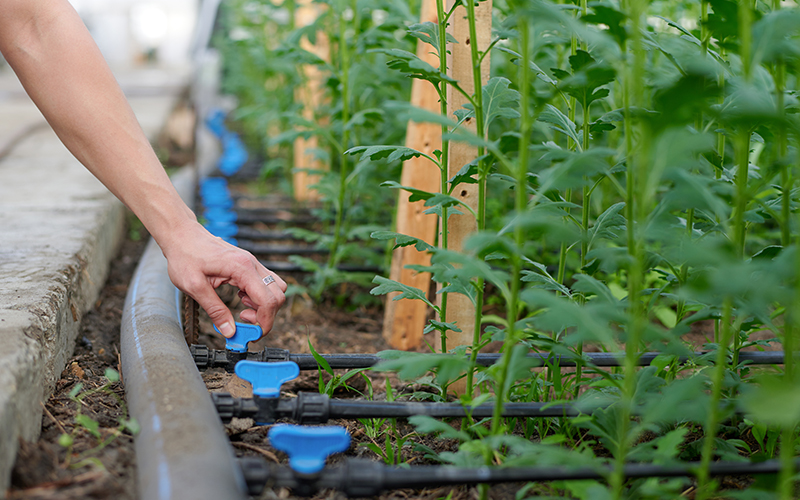
Fertigation is the main use. The operator dissolves fertilizer in a stock tank, and an injector meters it into the irrigation line at a set ratio.
Three practices separate good results from poor ones. The system should run clean water for ten to fifteen minutes before injection begins, so the lines are full and pressure is stable. Injection should then run for the middle portion of the irrigation cycle. Finally, the system should flush with clean water for another fifteen to twenty minutes, which clears fertilizer out of the emitters before the water stops.
Skipping the final flush is the most common mistake in the field. Fertilizer left standing in a warm drip line concentrates as water evaporates, and salts crystallise inside the emitter.
Foliar Spraying
Foliar sprays place nutrients directly on the leaf, where absorption takes hours rather than days. Typical concentrations run from 0.5% to 1.0%, which is 5 to 10 grams per litre of water.
Foliar feeding has two limits that suppliers should state plainly. The leaf can absorb only small quantities, so foliar application corrects a deficiency but cannot carry a crop’s full nutrient requirement. Micronutrients also stay where they land, because they do not move out of the leaf to other parts of the plant. Spraying a canopy will not fix a problem in the fruit.
Sprays work best in the early morning or late afternoon. Midday heat dries droplets before absorption finishes, and it raises the risk of leaf burn.
Hydroponics and Soilless Growing
Hydroponic systems depend entirely on soluble fertilizers, because there is no soil to buffer errors. Every nutrient the crop receives comes from the solution.
This raises the quality bar sharply. Insoluble particles accumulate in a recirculating system with nowhere to go, and impurities that a field soil would absorb build up instead. Growers running hydroponics should specify the highest purity grade available and check every batch.
Turf, Lawn, and Landscape Use
Golf courses, sports fields, and landscaped areas use soluble fertilizers for the same reason greenhouse growers do: control and speed. A turf manager can green a surface within days ahead of an event, then hold it steady with light, frequent feeding.
Soluble products also spread more evenly than granules on close-mown turf. Balanced grades with trace elements suit general maintenance, while higher-potassium grades improve wear tolerance and drought resistance through summer.
What Are the Benefits of Water Soluble Fertilizers?
Water soluble fertilizers offer six advantages over broadcast granular products.
Higher nutrient recovery. Nutrients arrive in the root zone in available form, so a larger share reaches the crop instead of being fixed in soil or lost to leaching.
Precise timing. Growers can match supply to demand week by week, feeding heavily during rapid growth and easing off as the crop matures.
Lower leaching losses. Small, frequent doses keep nutrient concentrations near the roots instead of pushing a large load through the profile after rain.
Water and labour savings. Fertilizer travels with irrigation water that the crop needs anyway, which removes a separate spreading operation.
Accurate micronutrient delivery. Trace elements are needed in grams per hectare, and no spreader can distribute that accurately. Dissolving them in irrigation water can.
Even distribution. A properly balanced system delivers the same solution to every emitter, which removes the striping that uneven spreading causes.
Why Water Quality Decides Success or Failure
Water quality determines whether a soluble fertilizer performs as intended. The same product can run cleanly in one location and block a system in another, and the difference lies in the water rather than the fertilizer.
Hardness, Calcium, and Precipitation
Hard water carries dissolved calcium and magnesium. When phosphate or sulfate fertilizers meet those ions, they form compounds that do not dissolve.
Calcium and phosphate form calcium phosphate, a white sludge that settles in tanks and blocks emitters. Calcium and sulfate form calcium sulfate, which coats filters. High pH makes both reactions faster, so alkaline hard water is the worst combination.
Two solutions work. Growers can inject acid ahead of the fertilizer to hold the line below pH 6.5, or they can choose acidic products such as MKP, technical MAP, or urea phosphate that lower pH as they dissolve.
Target pH and EC Ranges
Two measurements guide every fertigation programme.
pH controls nutrient availability. Most crops perform best with a solution between 5.5 and 6.5. Above pH 7, phosphorus and micronutrients begin to precipitate. Below pH 5, some crops suffer root damage and metals may become too available.
Electrical conductivity (EC) measures total dissolved salts and indicates solution strength. Most field and greenhouse crops sit between 1.5 and 3.0 mS/cm, with seedlings at the low end and mature fruiting crops at the high end. High EC pulls water out of roots instead of into them, which produces wilting that looks like drought.
Growers should measure both at the emitter rather than at the tank. Readings at the tank miss what the irrigation water itself contributes.
Tank Compatibility — What Must Never Be Mixed
Certain fertilizers must never share a concentrated stock tank. The table below sets out the rules.
| Calcium nitrate | Phosphates (MKP, MAP) | Sulfates (SOP, MgSO₄, AS) | Nitrates (KNO₃) | Urea | |
| Calcium nitrate | — | Never together | Never together | Compatible | Compatible |
| Phosphates | Never together | — | Compatible | Compatible | Compatible |
| Sulfates | Never together | Compatible | — | Compatible | Compatible |
| Nitrates (KNO₃) | Compatible | Compatible | — | — | Compatible |
| Urea | Compatible | Compatible | Compatible | Compatible | — |
The standard answer is a two-tank system:
- Tank A holds calcium nitrate, other nitrates, and chelated micronutrients.
- Tank B holds phosphates, sulfates, and the remaining micronutrients.
- Any acid goes into a third tank, or into Tank B.
One clarification saves operators from over-engineering. The restriction applies to concentrated stock solutions only. Once both tanks inject into flowing irrigation water, concentrations fall far enough that the two groups coexist without reacting. The products can meet in the main line; they simply cannot meet in the bucket.
How to Choose the Right Water Soluble Fertilizer
Selection follows five steps, and working through them in order narrows the choice quickly. Each step rules out options, so the final step usually leaves only one or two products in contention.
Match the Grade to the Growth Stage
The crop’s stage decides which nutrient should lead the mix.
Early growth calls for phosphorus to build roots, so technical MAP or a high-phosphorus balanced grade fits. Rapid vegetative growth calls for nitrogen, supplied by urea, ammonium sulfate, or a balanced grade. Flowering and fruit set call for phosphorus and potassium with restrained nitrogen, which is where MKP performs. Fruit filling and quality call for potassium, supplied by SOP, MOP, or potassium nitrate.
This is why most season-long programmes use three or four products rather than one. A single grade cannot match a demand curve that changes every few weeks.
Test the Irrigation Water Before Buying
A water analysis should come before any large purchase, because water chemistry rules out some products entirely.
The analysis should report pH, electrical conductivity, calcium, magnesium, and bicarbonate. Hard or alkaline water favours acidic products such as MKP, technical MAP, and urea phosphate, and it usually calls for acid injection as well. Soft water leaves the choice open.
The test costs very little against the price of a blocked irrigation system. Buyers who skip it are choosing a product without knowing the conditions it has to work in.
Set Purity by Application Method
The delivery method sets the minimum purity the product must meet.
Drip systems demand the lowest water-insoluble figure, because emitter openings are narrow and a single particle can block one. Sprinkler and foliar systems tolerate slightly more, since their openings are wider. Hydroponic systems demand the highest purity of all, because the solution recirculates and impurities have nowhere to go.
The insolubles limit belongs in the contract rather than in an assumption. A supplier who cannot state the figure cannot guarantee it.
Check the Crop’s Chloride Tolerance
Chloride tolerance decides which potassium source the crop can accept.
Sensitive crops such as tobacco, grapes, and strawberries need a chloride-free source, which means SOP or potassium nitrate. Tolerant crops such as cereals, rice, and sugar beet can take MOP and benefit from its lower cost.
Soil and climate shift this line as well. Fields already carrying a salt load, and regions with too little rainfall to leach salts away, need the chloride-free option even for crops that would normally tolerate it.
Choose Between Straight Products and Balanced Grades
The last step depends on the operation rather than the crop.
Operations with an agronomist and reliable mixing equipment gain more from straight products, because they can adjust one nutrient without touching the others. Operations without that support get better results from balanced grades, since fewer decisions mean fewer mistakes.
Many growers move along this path over time. They start with balanced grades to keep the system simple, then shift to straights as their water data, equipment, and agronomy improve.
What Are the Limitations and Risks of Water Soluble Fertilizers?
Water soluble fertilizers are not the right answer for every situation. Five limitations deserve attention.
High cost per unit of nutrient. Purification, crystallisation, and quality control all add cost. Soluble grades typically cost several times more per unit of nutrient than bulk granular products, which is why broadacre cereals rarely use them.
Dependence on equipment. The programme needs an injector, filtration, and someone who understands the system. Equipment failure stops the nutrition programme as well as the water.
Sensitivity to water chemistry. A product that performs in one location may fail in another with harder water, and no specification sheet can predict that on its own.
Strong moisture pickup. Soluble crystals absorb water from the air quickly. An opened bag left in a humid store cakes within days and becomes difficult to dose.
Risk of salt injury. Concentration errors show up fast because the nutrients are immediately available. Over-application scorches roots and leaves rather than simply wasting fertilizer.
How to Evaluate Water Soluble Fertilizer Quality Before You Buy?
Quality control starts with the specification sheet and ends with a test in the buyer’s own water. The table below lists the parameters that belong in a contract.
| Parameter | Standard Requirement | Why It Matters |
| Nutrient content | Within 0.5% of the stated grade | Confirms the label is genuine |
| Purity | 99% minimum for technical grades | The basis of every other figure |
| Water-insoluble matter | 0.2% maximum | The single most important quality figure |
| Moisture | Low, as specified | Prevents caking in the bag |
| pH of 1% solution | Within the stated range | Predicts behaviour in the irrigation line |
| Chloride | Stated figure, 1.5% maximum for chloride-free claims | Protects sensitive crops |
| Fluoride (as F) | 0.001% maximum | Protects sensitive crops and meets food-chain limits |
| Arsenic (as As) | 0.0003% maximum | Required for many destination markets |
| Heavy metals (Pb, Cd) | Per destination limits | Determines market access |
| Micronutrient chelation | Chelating agent named with chelation rate | Unchelated metals precipitate out |
Three checks turn that specification into protection. The supplier should issue a certificate of analysis for each production batch rather than a generic document. An independent agency should draw samples at the loading port and test them against the contract. The buyer should hold a sealed retention sample until the cargo clears customs.
One field test costs almost nothing and prevents the most common complaint. Buyers should dissolve a sample at the label rate in their own irrigation water, let the jar stand for two hours, then check the bottom for residue. A product that dissolves cleanly in laboratory water can still leave a deposit in hard water, and it is far better to learn that from a jar than from a blocked field. Importers sourcing across several nutrient groups often prefer a single partner for their fertilizer procurement, because consistent documentation and one point of contact simplify the whole process.
Market and Price Factors
Water soluble fertilizers sit in the specialty segment, so prices behave differently from bulk commodities. Four forces set the level.
Raw material costs flow through from the same base chemicals that drive bulk fertilizer prices. Ammonia, phosphoric acid, and potash all trace back to natural gas, phosphate rock, and mined potash.
Purification cost creates the premium. Turning a fertilizer-grade salt into a 99% pure soluble crystal requires additional crystallisation, filtration, and drying, and each step consumes energy.
Demand from protected cropping drives growth. Greenhouse vegetables, high-density orchards, and hydroponic systems all use soluble fertilizers intensively, and this segment expands faster than field agriculture.
Packaging and freight carry more weight than in bulk trade, because soluble grades need moisture-proof packaging and smaller bag formats.
One habit protects margins. Buyers should compare offers on delivered cost per unit of nutrient rather than price per tonne, and they should treat the insolubles figure as part of the price. A cheaper product that blocks emitters costs more than the invoice shows.
Packaging, Storage, and Handling
Water soluble fertilizers stay usable only while they stay dry. Their affinity for moisture is a direct consequence of the solubility that makes them valuable.
Packaging comes in three formats. Bags of 20 kg or 25 kg with a sealed inner liner suit greenhouse and horticultural use. Bags of 50 kg suit larger operations. Jumbo bags of 1,000 kg suit blending plants, and customised packing is available for specific markets.
The sealed liner is essential. Woven polypropylene alone does not block water vapour. A sealed polyethylene or aluminium-foil liner is the accepted barrier, and it has to survive handling as well as the voyage.
Storage requires a dry, covered building with a sealed floor. Bags belong on pallets rather than bare concrete, stacks should stand clear of exterior walls where condensation forms, and stack height needs a limit because pressure at the base accelerates caking.
Opened bags should be resealed the same day. This is the single most common cause of caking on farm, and it costs nothing to prevent.
Separation in store prevents accidental mixing. Calcium products should sit apart from phosphate and sulfate products, and fertilizers should not share space with pesticides or fuels.

FAQs
What is the difference between water soluble and liquid fertilizer?
Water soluble fertilizer is a dry crystal or powder that the operator dissolves before use. Liquid fertilizer arrives already dissolved. Liquids save a mixing step, but 70% to 90% of their weight is water, which makes them expensive to ship any distance.
Which nitrogen fertilizers are water soluble?
Urea, ammonium sulfate, ammonium chloride, calcium nitrate, and potassium nitrate all dissolve fully. They differ in nitrogen form, which changes how fast the crop responds and how the product affects soil pH.
Can water soluble fertilizer be used on lawns?
Yes. Turf managers use soluble fertilizers on golf courses, sports fields, and landscaped areas because they act quickly and spread evenly on close-mown grass. Light, frequent applications work better than a single heavy dose.
How much water soluble fertilizer per litre of water?
Foliar sprays normally use 5 to 10 grams per litre, which is a 0.5% to 1.0% solution. Fertigation rates depend on the injector ratio and the crop, so the label and a local agronomist should set the figure.
Can water soluble fertilizers be mixed with pesticides?
Many combinations work, but compatibility must be confirmed for each pair before mixing at scale. A small jar test using the intended water and rates will show any reaction. Calcium-containing fertilizers need particular care.
Why does water soluble fertilizer leave residue in the tank?
The usual causes are high water-insoluble matter in the product, mixing incompatible fertilizers in one stock tank, hard water reacting with phosphates or sulfates, or water too cold for the product to dissolve fully.
Conclusion
Water soluble fertilizers give growers something granular products cannot: control. Nutrients arrive in available form, at the stage the crop needs them, in doses the grower sets week by week. On high-value crops, that control decides both yield and quality.
The purchase decision rests on three things rather than price alone. The water-insoluble figure determines whether the product will run through the system. The water analysis determines which products suit the location. The tank layout determines whether the programme works in daily practice. A jar test with the buyer’s own water answers most questions before an order is placed.
SUMEC Chemical supplies water soluble fertilizers alongside a full range of nitrogen, phosphate, and potash products to importers, blenders, and distributors worldwide. Every shipment carries batch-level documentation, and the export team handles inspection, packaging, and port logistics as part of the order.
Buyers who need a specification sheet, a sample for jar testing, or a current quotation for their market can contact the SUMEC Chemical team directly. A short conversation about crop, irrigation water, and application method is usually enough to confirm the right grades and packing format.