

CAN Fertilizer (Calcium Ammonium Nitrate): The Complete Guide
A tomato crop can look perfect for eight weeks and still lose a third of its fruit to blossom-end rot. The soil test shows plenty of calcium. The fruit still fails.
Calcium is the reason. It moves through the plant in the water stream, and it does not move again once it arrives. A fruit that misses its calcium during cell division cannot recover later, no matter how much the grower applies afterwards.
CAN fertilizer solves this problem. It supplies calcium in a fully soluble form alongside nitrate nitrogen, so growers can feed both through an irrigation line at the exact stage the crop needs them. The standard commercial grade contains at least 15% nitrogen and at least 25% calcium oxide.
This guide explains what CAN is, how manufacturers produce it, and where it performs best. It also covers the parts that matter to importers: quality specifications, tank compatibility, price drivers, and storage.
What Is CAN Fertilizer (Calcium Ammonium Nitrate)?
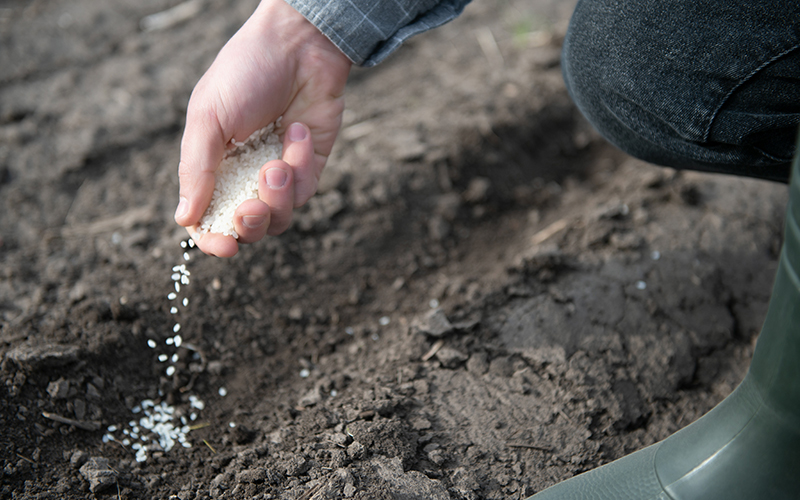
CAN fertilizer is a granular, fully water-soluble fertilizer that supplies calcium and nitrate nitrogen in one product. Manufacturers produce it by reacting limestone with nitric acid and then adding ammonia to form a stable double salt.
The industry classes it as a calcium fertilizer rather than a straight nitrogen product. Growers choose it when the crop needs calcium, when the nitrogen should arrive in nitrate form, or when both are true at once. Fruit and vegetable producers are the largest users.
CAN Fertilizer Full Form and Chemical Formula
The full form of CAN is calcium ammonium nitrate. Its chemical formula is Ca(NO₃)₂·NH₄NO₃, and its CAS number is 15245-12-2.
The molecule is a double salt. It combines calcium nitrate with a smaller share of ammonium nitrate, which produces a granule that handles better than calcium nitrate alone.
Both nutrients dissolve completely. This matters more than it sounds, because most calcium sources used in agriculture do not dissolve at all. Gypsum and limestone release calcium slowly over months, and they cannot pass through an irrigation line. CAN puts calcium into solution within minutes.
What N 15% and CaO 25% Mean
The two figures on the specification sheet describe the guaranteed minimum content of each nutrient. Commercial CAN carries at least 15% total nitrogen and at least 25% calcium oxide.
A 50 kg bag therefore holds a minimum of 7.5 kg of nitrogen and 12.5 kg of calcium oxide. Calcium oxide is the trade convention for reporting calcium, and 25% CaO works out to roughly 18% elemental calcium.
The nitrogen breakdown matters as much as the total. Almost all of it is nitrate nitrogen, with only a small ammoniacal fraction. Nitrate is the form roots absorb directly, so the crop responds within days rather than weeks. Nitrate uptake also helps the root pull calcium in alongside it, which is why the two nutrients work well together in one product.
Two Products, One Name — Which CAN Is Which
Buyers should know that the name calcium ammonium nitrate covers two different fertilizers on the world market. Ordering the wrong one is a common and expensive mistake.
| Feature | CAN, calcium nitrate type (this guide) | CAN, limestone type |
| Composition | Ca(NO₃)₂·NH₄NO₃ double salt | Ammonium nitrate mixed with ground limestone |
| Total nitrogen | 15% minimum | Around 26% to 27% |
| Calcium as CaO | 25% minimum | Roughly 6% to 10% |
| Water solubility | Full | Partial, the limestone does not dissolve |
| Fertigation and foliar use | Suitable | Not suitable |
| Primary purpose | Calcium supply plus nitrate nitrogen | Nitrogen top dressing |
The product described throughout this guide is the calcium nitrate type. It is a soluble calcium fertilizer, and its value lies in the calcium as much as in the nitrogen.
The practical test is the specification sheet, not the name. A product at 15% N with 25% CaO is the soluble calcium type. A product near 27% N with a low calcium figure is the limestone type. Buyers who confirm the analysis before ordering avoid receiving a fertilizer that cannot pass through their drip system.
Key Physical and Chemical Properties at a Glance
The table below lists the values that shape handling and field performance.
| Property | Typical Value |
| Chemical formula | Ca(NO₃)₂·NH₄NO₃ |
| CAS number | 15245-12-2 |
| Appearance | White to off-white granules |
| Granule size | 2–5 mm |
| Purity | 99% minimum |
| Total nitrogen | 15% minimum |
| Calcium as CaO | 25% minimum |
| Nitrogen form | Mostly nitrate, small ammoniacal fraction |
| Water solubility | About 1,200 g per litre at 20 °C |
| pH of 1% solution | Around 6, close to neutral |
| Effect on soil pH | Slightly raises pH |
| Moisture behaviour | Strongly hygroscopic |
Two rows drive most practical decisions. The solubility figure of roughly 1,200 g per litre is among the highest of any fertilizer, which is what makes CAN a fertigation product. The hygroscopic behaviour is the opposite side of the same property, and it explains why every storage rule in this guide comes back to keeping bags sealed.
How Is CAN Fertilizer Made?
Manufacturers produce CAN in four stages, starting from limestone and nitric acid.
Stage one dissolves the limestone. Nitric acid reacts with ground limestone, which yields a calcium nitrate solution and releases carbon dioxide. The purity of the limestone at this point sets the impurity level of the finished product, so producers control the rock source closely.
Stage two adds ammonia. Controlled ammonia addition converts part of the solution into the double salt and neutralises any remaining free acid. This step gives the product its ammoniacal nitrogen fraction and its stable crystal structure.
Stage three concentrates and granulates. Evaporators remove water, and the concentrated melt passes through a granulator that forms particles of 2 to 5 mm. The granules then move through a dryer and a cooler.
Stage four screens and coats. Screens remove oversize and undersize particles, which return to the process. On-size granules receive an anti-caking coating before bagging. For a fertilizer this hygroscopic, the coating and the sealed liner together decide whether the cargo arrives free-flowing or as a solid block.
What Are the Benefits of CAN Fertilizer?
CAN offers six advantages that other calcium and nitrogen sources cannot match at the same time.
It delivers calcium in a usable form. Most soils contain calcium, but much of it is locked in compounds that release slowly. CAN dissolves fully, so the calcium reaches the root zone the same day the grower applies it.
It works through irrigation systems. Full solubility means CAN can pass through drip lines, sprinklers, and injectors. Growers can therefore split calcium into many small doses rather than one large soil application.
It supplies nitrogen in nitrate form. Roots absorb nitrate immediately with no conversion step. The crop responds within days, which suits corrective feeding and peak-demand stages.
The two nutrients help each other. Nitrate uptake at the root surface supports calcium uptake alongside it. A product that supplies both therefore performs better than the same nutrients applied separately.
It improves fruit quality and shelf life. Calcium builds and strengthens cell walls. Fruit with adequate calcium resists cracking, handles transport better, and holds condition longer in storage.
It does not acidify soil. CAN has a slightly alkaline reaction. On soils already under pressure from years of urea or ammonium sulfate, this protects pH rather than lowering it further.
What Are the Main Uses of CAN Fertilizer?
Most CAN goes to high-value fruit and vegetable crops, applied through irrigation. A smaller share goes to soil application and to compound fertilizer production as a raw material.
Correcting Calcium Disorders in Fruit and Vegetables
The clearest use of CAN is preventing calcium deficiency disorders. These disorders share one cause and appear in several forms.
Blossom-end rot shows as a sunken dark patch at the base of tomatoes, peppers, and watermelons. Bitter pit appears as brown spots under the skin of apples. Tip burn scorches the inner leaves of lettuce and cabbage. All three trace back to calcium failing to reach the growing tissue at the right moment.
Timing decides the outcome. Calcium travels in the transpiration stream and does not redistribute once it settles, so the crop needs a steady supply during cell division rather than a single large dose later. Growers therefore apply small amounts of CAN through the irrigation line from early fruit set onward.
Fertigation Through Drip and Sprinkler
Fertigation is the main delivery method for CAN. The granules dissolve completely and leave no residue, so they suit drip emitters, micro-sprinklers, and centre pivots.
The practical benefit is control. A grower can adjust the calcium and nitrogen rate week by week as the crop moves through its stages, and can stop nitrogen late in the season while continuing calcium. Granular soil products cannot offer that flexibility.
One rule governs every fertigation programme using CAN, and the section on tank compatibility below explains it in full.
Foliar Spraying
Foliar sprays deliver calcium directly to the tissue that needs it. Typical solutions run from 0.5% to 1.0%, which is roughly 5 to 10 grams per litre of water.
Foliar calcium has a real limit that suppliers should explain honestly. Calcium does not move from a leaf to a fruit, so spraying the canopy will not fix a fruit disorder. The spray has to land on the fruit itself, and it usually needs repeating every seven to fourteen days through the sensitive period.
Foliar application supplements a soil or fertigation programme. It does not replace one.
Soil Application on Acidic Soils
CAN also works as a straight soil-applied fertilizer, spread and watered in. This suits open-field vegetables and orchards without irrigation infrastructure.
Acidic soils benefit most. They tend to be low in calcium because rainfall has leached it away, and the slightly alkaline reaction of CAN adds calcium without pushing pH downward. On these soils CAN complements a liming programme rather than replacing it, since lime corrects pH while CAN supplies calcium the crop can use immediately.
Which Crops Benefit Most from CAN?
Crops that produce fruit or dense heads gain the most from CAN, because these tissues transpire little and struggle to pull calcium in on their own. The table below gives common starting ranges.
| Crop Group | Examples | Common Rate | Timing |
| Fruiting vegetables | Tomato, pepper, watermelon | 5–15 kg/ha per fertigation | Weekly from fruit set |
| Leafy vegetables | Lettuce, cabbage, celery | 5–10 kg/ha per fertigation | Every 7–14 days |
| Pome and stone fruit | Apple, pear, cherry | 100–200 kg/ha per season | Split from fruit set to harvest |
| Citrus | Orange, lemon, mandarin | 100–200 kg/ha per season | Split across the growing season |
| Root and tuber crops | Potato, carrot, onion | 80–150 kg/ha | Split during bulking |
| Field crops | Maize, cotton, soybean | 100–200 kg/ha | At active vegetative growth |
These figures are starting points. A soil test and a leaf analysis should set the final rate, because calcium availability varies widely with soil type and irrigation water.
One planning point applies across the table. CAN supplies calcium and nitrogen only. It carries no phosphorus, no potassium, and no magnesium, so a complete programme pairs it with a phosphate source and a potash source. Chloride-sensitive crops such as tomatoes, grapes, and tobacco need a sulfate-based potash rather than a chloride source, and the potassium chloride buying guide explains that choice in detail.
How and When Should CAN Fertilizer Be Applied?
Calcium behaves differently from nitrogen, phosphorus, and potassium, so the usual application logic does not transfer. Little and often beats one large dose.
Application Methods and Rates
Three methods cover almost all commercial use.
Fertigation dissolves CAN into irrigation water at 5 to 15 kg per hectare per application. Growers repeat this weekly or fortnightly through the sensitive period. This method gives the best control and the most reliable results.
Foliar spraying applies a 0.5% to 1.0% solution directly to the crop. The spray must reach the fruit surface to prevent fruit disorders, and it works as a supplement rather than a base programme.
Soil application spreads 80 to 200 kg per hectare, followed by irrigation or rainfall to move the nutrients into the root zone. This suits crops without a fertigation system.
Timing by Growth Stage
Calcium demand peaks during cell division, which happens early. For fruit crops this means the first four to six weeks after the fruit set, and applications made after that window cannot correct a problem that has already formed.
Nitrogen demand follows a different curve. It peaks during rapid vegetative growth and should taper as fruit ripens, since late nitrogen delays colouring and softens fruit.
These two curves explain a common programme design. Growers use CAN heavily during early fruit development, when both nutrients are wanted, then switch to a calcium-only or low-nitrogen source later in the season while continuing to supply calcium.
Tank Compatibility — What CAN Must Never Be Mixed With
CAN must never share a concentrated stock tank with phosphate or sulfate fertilizers. This is the single most important handling rule for the product.
The chemistry is straightforward. Calcium reacts with phosphate to form calcium phosphate, and with sulfate to form calcium sulfate. Both compounds are insoluble. They settle as a white sludge in the tank, block filters, and clog drip emitters, and clearing a blocked drip line is far more expensive than the fertilizer itself.
The standard solution is a two-tank system:
- Tank A holds CAN, other nitrates, and chelated micronutrients.
- Tank B holds phosphates, sulfates, and the remaining micronutrients.
- Any acid goes into a separate tank, or into Tank B.
One clarification prevents confusion. The restriction applies to concentrated stock solutions, not to the diluted mixture in the main irrigation line. Once both tanks inject into flowing water, concentrations drop far enough that the two groups coexist safely. Growers who believe the products can never meet at all will build a system far more complex than they need.
CAN vs Urea vs Other Nitrogen Sources
CAN and urea are not direct substitutes, even though both supply nitrogen. They serve different purposes, and the table below shows why.
| Factor | CAN (15% N, 25% CaO) | Urea (46% N) | Ammonium sulfate (21% N) |
| Nitrogen content | 15% | 46% | 21% |
| Nitrogen form | Mostly nitrate | Amide, converts in soil | Ammonium |
| Speed of response | Immediate | Several days to two weeks | Moderate |
| Extra nutrients | 25% CaO | None | 24% sulfur |
| Water solubility | Full | Full | Full |
| Effect on soil pH | Slightly raises | Acidifying over time | Strongly acidifying |
| Cost per unit of nitrogen | Highest | Lowest | Moderate |
| Main purpose | Calcium supply plus fast nitrogen | Bulk nitrogen | Nitrogen plus sulfur |
Nobody buys CAN as a low-cost nitrogen source. At 15% N it carries roughly a third of the nitrogen of urea, so the cost per unit of nitrogen is far higher.
Buyers should judge it on the calcium instead. The correct comparison is against other calcium sources, and against the value of the fruit that calcium protects. A vegetable grower who loses part of a crop to blossom-end rot is comparing the fertilizer cost with the value of that lost fruit, not with a bag of urea.
Most programmes therefore use both. Urea or another bulk product covers the main nitrogen requirement, while CAN handles calcium and the fast nitrate portion at the stages that matter.
What Are the Limitations and Risks of CAN?
CAN is not the right choice in every situation. Five limitations deserve attention before an order is placed.
Low nitrogen concentration. At 15% N, CAN is an expensive way to buy nitrogen alone. Its value depends on the calcium.
Very high moisture sensitivity. CAN absorbs water from the air faster than almost any other fertilizer. An opened bag left in a humid store will turn to a wet mass within days.
Strict tank incompatibility. The restriction against mixing with phosphates and sulfates in stock solution adds equipment cost and demands trained operators.
Nitrate leaching. Nitrate does not bind to soil particles, so heavy rain or over-irrigation can carry it below the root zone. Split applications limit this loss.
No phosphorus, potassium, or magnesium. CAN covers two nutrients. Any complete programme requires other products alongside it.
How to Evaluate CAN Fertilizer Quality Before You Buy?
Quality control starts with the contract specification and ends with an independent inspection at the loading port. The table below lists the parameters that belong in the contract.
| Parameter | Standard Requirement | Why It Matters |
| Purity | 99% minimum | Confirms the product is not diluted |
| Total nitrogen | 15% minimum | Verifies the grade |
| Calcium as CaO | 25% minimum | The main reason for buying the product |
| Nitrate nitrogen share | Majority of total N | Governs speed of crop response |
| Water-insoluble matter | Low, as specified | Decides whether it will clog emitters |
| Moisture | Low, as specified | The main driver of caking |
| pH of 1% solution | Around 6 | Predicts behaviour in the irrigation line |
| Granule size | 2–5 mm | Protects flow and spreading accuracy |
| Anti-caking coating | Applied and stated in the contract | Essential for long sea transport |
Three checks turn that specification into real protection. The supplier should issue a certificate of analysis for each production batch rather than a generic document reused across shipments. An independent agency should draw samples at the loading port and test them against the contract. The buyer should hold a sealed retention sample until the cargo clears customs, which settles most disputes quickly.
One extra test costs almost nothing and prevents the most common complaint. Buyers should dissolve a sample at the label rate in their own irrigation water, let the jar stand for two hours, then check the bottom for residue. A product that dissolves cleanly in laboratory water can still leave a deposit in hard water, and it is better to learn that from a jar than from a blocked field. Importers sourcing across several nutrient groups often prefer a single partner for their fertilizer procurement, because consistent documentation and one point of contact simplify the whole process.
CAN Fertilizer Market and Price Factors
CAN sits in the specialty fertilizer segment, so its price behaves differently from bulk commodities such as urea or DAP. Four forces set the level.
Raw material costs start with nitric acid and limestone. Nitric acid comes from ammonia, and ammonia comes from natural gas, so energy prices reach the CAN market through that chain.
Processing cost carries more weight than in bulk fertilizers. Evaporation, granulation, and coating all consume energy, and the purity required for fertigation grades adds further cost.
Demand from protected cropping drives the specialty end of the market. Greenhouse vegetables, high-density orchards, and hydroponic systems all use CAN intensively, and this segment grows faster than field agriculture.
Freight and packaging matter because CAN needs moisture-proof packaging that bulk products do not. That requirement adds cost per tonne and rules out some low-cost shipping options.
One habit protects margins. Buyers should compare offers on delivered cost per unit of calcium oxide rather than per tonne, since calcium is the reason for the purchase.
Packaging, Storage, and Shipping Requirements for CAN
CAN travels well only when it stays sealed. Its strong affinity for moisture makes packaging the central requirement at every stage.
Packaging comes in three standard formats. Bags of 20 kg or 50 kg with a sealed inner liner suit distribution and greenhouse use. Jumbo bags of 1,000 kg suit large farms and blending operations. Customised packing is available for specific market requirements.
The sealed inner liner is not optional. Woven polypropylene alone does not stop water vapour. A sealed polyethylene or aluminium-foil liner is the accepted barrier, and the seal has to survive handling as well as the voyage.
Storage requires a dry, covered building with a sealed floor. Bags belong on pallets, never on bare concrete, and stacks should stand clear of exterior walls where condensation forms. Stack height needs a limit, because pressure at the base accelerates caking. Opened bags should be resealed the same day.
Container loading benefits from a full plastic liner and desiccant bags. Steel walls sweat during an ocean crossing, and condensation dripping onto the top layer is enough to ruin it.
Separation in store is good practice. CAN should sit apart from phosphate and sulfate products to prevent accidental mixing, and away from any incompatible materials in a clean, well-ventilated space. Shippers should confirm current transport and storage requirements with the carrier and the destination authority before booking.
FAQs
What is the full form of CAN fertilizer?
CAN stands for calcium ammonium nitrate. The soluble grade covered in this guide has the formula Ca(NO₃)₂·NH₄NO₃ and supplies at least 15% nitrogen and at least 25% calcium oxide.
Is CAN fertilizer water soluble?
Yes. CAN dissolves completely, at roughly 1,200 grams per litre of water at 20 °C. This makes it suitable for drip irrigation, sprinkler systems, and foliar spraying.
What is CAN fertilizer used for?
CAN supplies calcium and nitrate nitrogen. Growers use it to prevent calcium disorders such as blossom-end rot in tomatoes, bitter pit in apples, and tip burn in lettuce, and to deliver fast-acting nitrogen at peak demand.
Can CAN fertilizer be mixed with other fertilizers?
Not in a concentrated stock tank with phosphates or sulfates, because calcium reacts with both to form insoluble compounds that clog emitters. A two-tank system solves this. Once diluted in the main irrigation line, the products coexist safely.
How much calcium does CAN fertilizer contain?
At least 25% as calcium oxide, which is roughly 18% elemental calcium.
Does CAN fertilizer make soil acidic?
No. CAN has a slightly alkaline reaction and raises soil pH marginally. This distinguishes it from urea and ammonium sulfate, which acidify soil with repeated use.
How should CAN fertilizer be stored?
CAN should be stored indoors on pallets, in sealed bags with an inner liner, in a dry and well-ventilated building. It absorbs moisture from the air faster than most fertilizers, so opened bags must be resealed promptly.
Conclusion
CAN fertilizer earns its place in the specialty segment because it does something bulk products cannot. It puts calcium into solution, delivers it through an irrigation line, and pairs it with nitrate nitrogen that the crop can use the same day. For fruit and vegetable growers, that combination protects the part of the crop that carries the most value.
The buying side needs matching discipline. Verified nitrogen and calcium figures, a low insolubles result, sealed moisture-proof packaging, and a two-tank fertigation setup protect the value of every tonne shipped. With this product, packaging and handling are not details. They decide whether the fertilizer works at all.
SUMEC Chemical supplies CAN together with a full range of nitrogen, phosphate, potash, and water-soluble fertilizers to importers, blenders, and distributors worldwide. Every shipment carries batch-level documentation, and the export team handles inspection, packaging, and port logistics as part of the order.
Buyers who need a CAN specification sheet, a sample analysis, or a current quotation for their market can contact the SUMEC Chemical team directly. A short conversation about crop plan, irrigation setup, and destination requirements is usually enough to confirm the right grade and packing format.