

HDPE vs. LDPE: Differences in Properties, Uses, and Processing
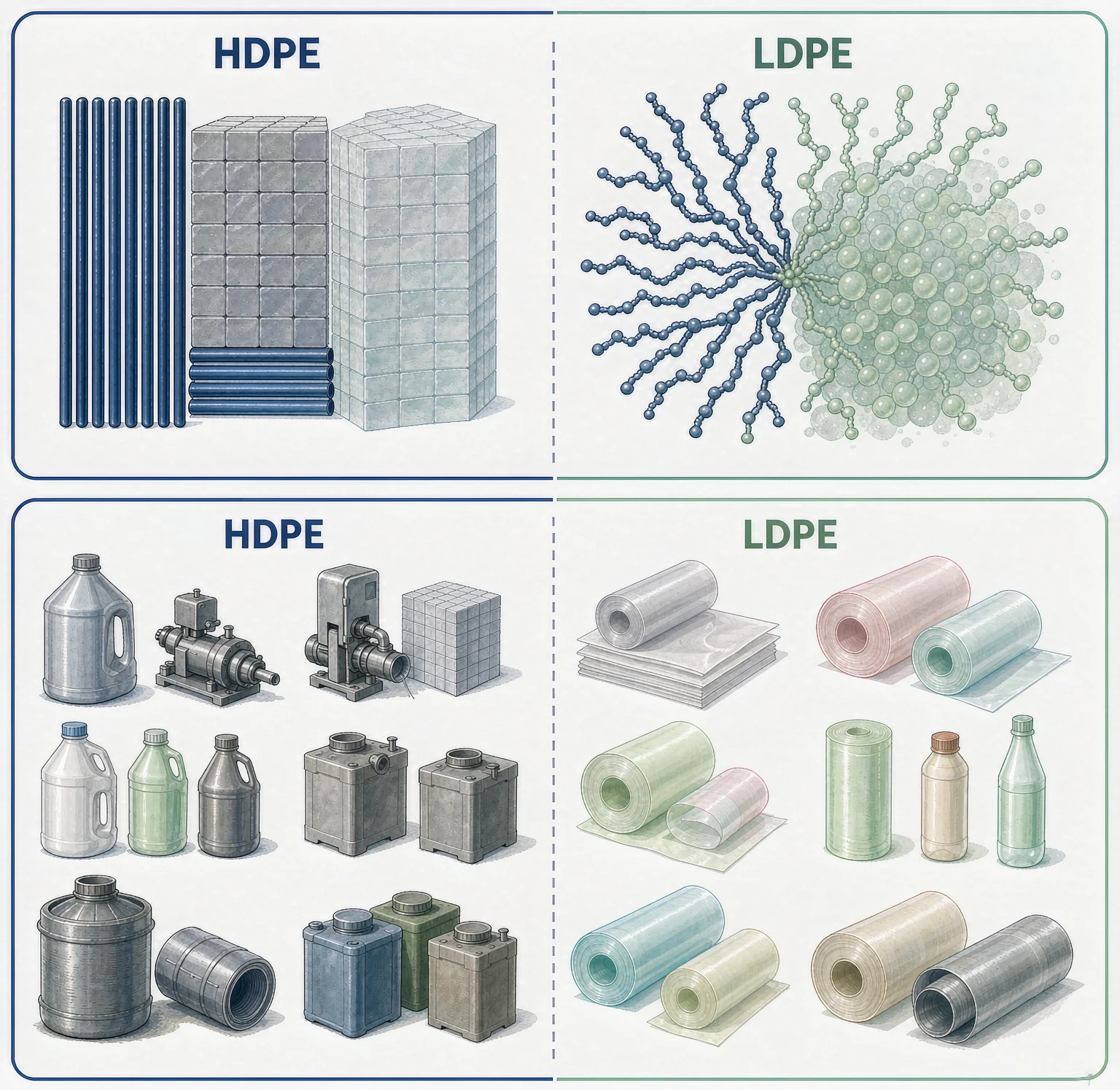
High-Density Polyethylene (HDPE) and Low-Density Polyethylene (LDPE) are the two oldest commercial grades of the polyethylene (PE) family. Both are homopolymers of ethylene (–CH₂–CH₂–)ₙ, yet they behave like different materials in service. The reason is not chemistry but topology: HDPE is essentially linear, LDPE is densely branched. That single architectural difference cascades into crystallinity, density, stiffness, barrier behavior, melt rheology, machine settings, and final part design.
The fundamental split between HDPE and LDPE is therefore not “which is safer or healthier” (the framing your bottled-water article used) but which chain architecture matches the mechanical and processing envelope of the part. Neither is universally superior; HDPE trades flexibility for load-bearing capacity, LDPE trades stiffness for low-temperature toughness and easy conversion into thin film.
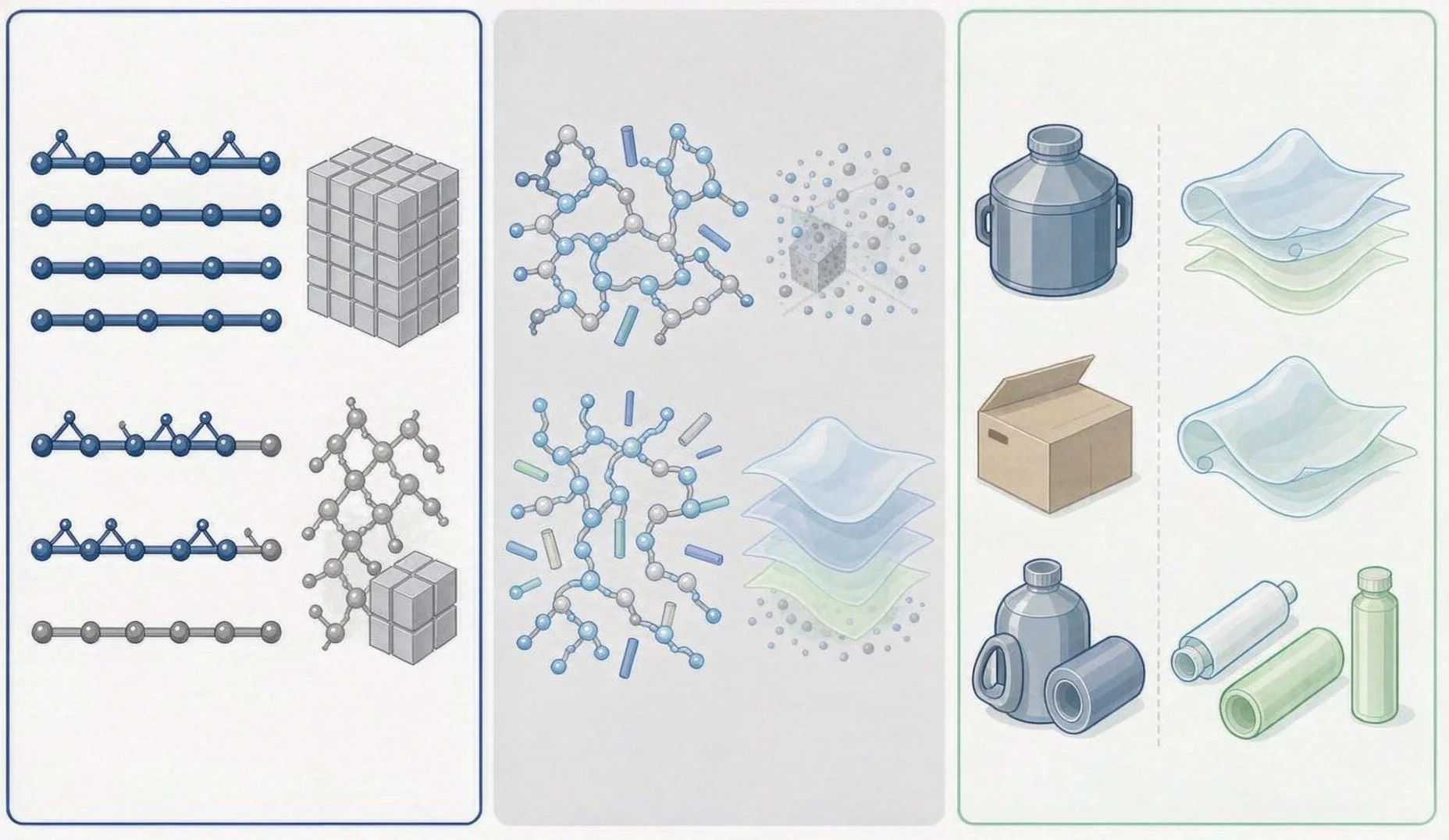
Table of Contents
- What Is HDPE?
- What Is LDPE?
- What Are The Differences Between HDPE And LDPE?
- Molecular Structure & Polymerization Routes
- Physical & Mechanical Property Differences
- Thermal, Barrier & Chemical Resistance Differences
- Processing & Machine-Setting Differences
- Application & Market-Segment Differences
- Cost, Recycling & Sustainability Differences
- Overall Pros And Cons
- Advantages Of HDPE Over LDPE
- Advantages Of LDPE Over HDPE
What Is HDPE?
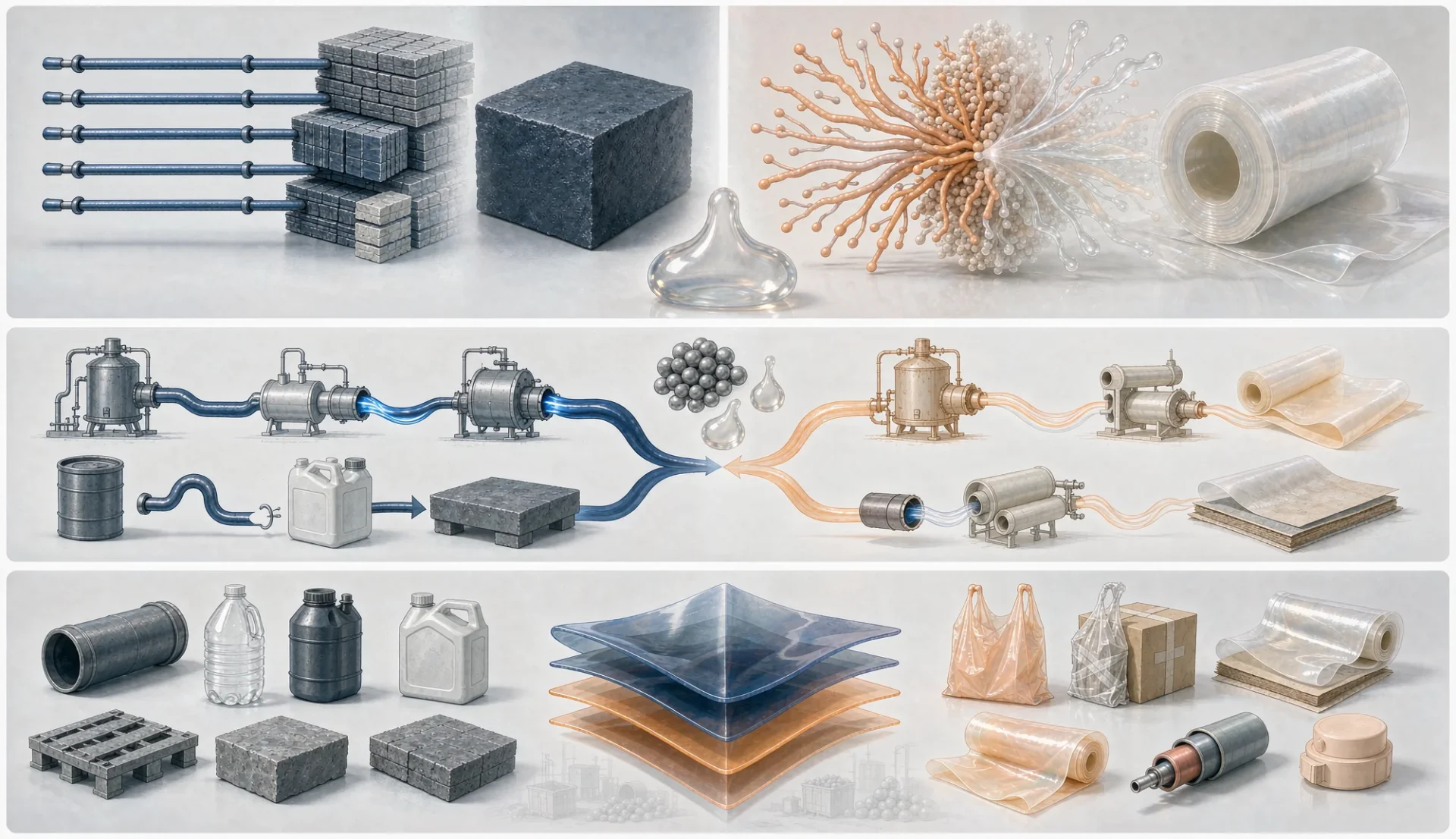
HDPE is a linear polyethylene synthesized by low-pressure coordination polymerization (0.1–5 MPa) using Ziegler–Natta or metallocene catalysts. The catalytic mechanism suppresses side reactions that create branches; typical short-chain branch frequency is 5–7 per 1000 carbon atoms, against 20–30 for LDPE. Chains pack into lamellar crystals with crystallinity 70–90%, giving density 0.941–0.965 g/cm³ (ASTM D792) and a translucent-to-opaque appearance.
Under ASTM D1248 it is “Type III” polyethylene; under ISO 1872-1 it is PE-HD. DSC melting point sits at 130–138 °C, tensile yield strength 20–45 MPa, flexural modulus 0.8–1.5 GPa, Shore D hardness 60–70. Because crystals carry load, HDPE is the default resin for pressure pipe, rigid blow-molded containers, and rotomolded tanks.
What Is LDPE?
LDPE is produced by high-pressure free-radical polymerization (100–350 MPa, 150–300 °C) in autoclave or tubular reactors. Radical transfer reactions graft both long and short chains off the backbone; branch frequency reaches 20–30 per 1000 carbons, which blocks close packing. Crystallinity falls to 40–60%, density to 0.910–0.940 g/cm³, melting point to 105–115 °C.
ASTM D1248 calls it “Type I”; ISO 1872 lists it as PE-LD. Tensile strength is 8–25 MPa, flexural modulus only 0.15–0.4 GPa, elongation at break 300–600%, Shore D 40–50. The amorphous fraction dominates deformation, so LDPE is soft, conformable, and the dominant resin for blown film, extrusion coating, and flexible closures.
What Are The Differences Between HDPE And LDPE?
HDPE and LDPE are both widely‑used polyethylene materials, yet their polymerization processes and molecular structures create notable gaps in mechanical performance. The table below outlines their key distinctions.
Core Comparison Table
| Dimension | HDPE | LDPE |
| Polymerization | Low-pressure, Ziegler–Natta/metallocene | High-pressure free-radical (100–350 MPa) |
| Chain architecture | Linear, <7 branches/1000 C | Highly branched, 20–30/1000 C |
| Crystallinity | 70–90% | 40–60% |
| Flexural modulus (GPa) | 0.8–1.5 | 0.15–0.4 |
| Elongation at break | 200–600% | 300–600% (often higher) |
| O₂ transmission (film) | 5–10× lower than LDPE | High, 5–10× HDPE |
| ESCR | Good (10× LDPE in std grade) | Poor |
| Dominant processes | Blow molding, pipe ext, rotomold, inj | Blown film, cast film, ext coating, inj |
| Recycling code | #2 (sinks in water) | #4 (near-neutral buoyancy) |
| Relative resin cost | Lower (efficient catalyst route) | Higher (high-pressure energy) |
1. Molecular Structure & Polymerization Routes
HDPE and LDPE start from the same monomer but never meet in the reactor. HDPE’s catalytic polymerization keeps the growing chain linear; chain-transfer-to-monomer is suppressed, so few ethyl/butyl side groups appear. LDPE’s radical mechanism intrinsically produces backbiting: the radical chain folds back on itself, terminates as a short or long branch, and continues growing. Those branches are not defects—they are the product identity.
Consequence chain:
- Linear → tight packing → high crystallinity → high modulus/density/barrier.
- Branched → loose amorphous phase → low modulus/density → high flexibility/low Tm.
This is why a 200 µm HDPE shopping bag feels like cloth-board and a 200 µm LDPE cling film drapes like fabric.
2. Physical & Mechanical Property Differences
Stiffness vs flexibility. HDPE flexural modulus (0.8–1.5 GPa) is roughly 3–5× LDPE’s (0.15–0.4 GPa). A banana-packaging study measured HDPE film at E≈950 MPa and LDPE at roughly one-third that, while LDPE kept ≈4× the elongation of HDPE.
Strength. HDPE yield stress 20–45 MPa vs LDPE 8–25 MPa; in postharvest film tests HDPE held ≈28 MPa tensile vs LDPE’s lower load-before-yield behavior with much higher draw.
Toughness mapping. LDPE retains ductility below −50 °C; HDPE is tougher than many plastics but shows colder brittle transition around −70 °C and is more notch-sensitive under sustained load.
Hardness/clarity. Shore D 60–70 (HDPE) vs 40–50 (LDPE). HDPE’s spherulites scatter light → opaque/translucent; LDPE thin film haze 5–10%, HDPE haze 40–60%.
ESCR. Standard HDPE resists environmental stress cracking roughly 10× better than LDPE, which matters in detergent bottles and buried pipe; for surfactant contact, HDPE still needs enhanced-ESCR copolymer grades.
3. Thermal, Barrier & Chemical Resistance Differences
- Melting: HDPE 130–138 °C, LDPE 105–115 °C (DSC). HDPE survives hot-fill; LDPE limits to <80 °C service.
- Moisture barrier: Both absorb <0.01% water in 24 h, but HDPE’s tighter crystal lattice cuts water vapor transmission below LDPE.
- Gas barrier: O₂ transmission of LDPE film is 5–10× that of HDPE; HDPE is preferred for hydrocarbon containment, LDPE for breathable medical packs.
- Chemical resistance: HDPE resists oils, fats, many solvents, and surfactants; LDPE resists acids/alkalis but swells in hydrocarbons and grease.
- UV: Both degrade under sunlight; outdoor HDPE pipe/geomembrane compounds use 2–3% carbon black, LDPE film uses HALS/UV absorbers.
4. Processing & Machine-Setting Differences
HDPE’s higher crystallinity releases latent heat on cooling → needs stronger mold cooling and is warp-prone if gate/shrinkage is unbalanced. LDPE’s low viscosity and broad MFI range make it forgiving but flash-prone.
Injection molding
- HDPE: melt 180–250 °C, mold 40–65 °C, gate away from critical faces, shrinkage 1.5–4.0%.
- LDPE: melt 160–210 °C, mold 20–50 °C, fast fill for thin wall, shrinkage up to 5% in thin sections.
Blown film
- LDPE: 160–200 °C barrel, BUR 2.5–3.0, dominates 70% of LDPE consumption.
- HDPE: 180–230 °C barrel, BUR 3–6, stiffer layflat, used for T-shirt bags and liner film.
Extrusion blow molding
- HDPE: 190–240 °C melt, blow pressure 0.4–0.7 MPa, milk/jerry cans.
- LDPE: 160–210 °C, blow pressure 0.2–0.4 MPa, squeeze tubes.
Pipe extrusion (HDPE only at scale)
- Barrel 180–230 °C, die 200–240 °C, melt pressure monitored, cooling in vacuum calibrator, DN200 die gap 1.5–2.0 mm.
Extrusion coating (LDPE dominant)
- LDPE coated onto carton/paper at 160–260 °C nip, low melt viscosity gives uniform web wet-out; HDPE used only in coextruded barrier layers.
5. Application & Market-Segment Differences
HDPE owns rigid/structural segments
- Pressure pipe: potable water, gas distribution, sewer, geothermal (PN-rated).
- Blow-molded containers: milk, detergent, shampoo, industrial chemical drums.
- Rotomolded tanks: 500 L–10 m³ storage, kayaks, playground units.
- Injection: crates, pallets, caps, automotive fuel tanks, geomembrane sheets.
LDPE owns flexible/converting segments
- Blown film: grocery bags, trash bags, bread/frozen-food film, agricultural mulch.
- Extrusion coating: milk carton inner layer, cup stock, lidding.
- Wire & cable: low-smoke insulation and semi-conductive shields.
- Molded flexibles: squeeze bottles, dispensing closures, lab wash bottles, tube liners.
Coextrusion and multi-layer structures routinely put HDPE as the stiff/barrier ply and LDPE as the heat-seal ply—so the “vs” in real converting is often “and”.
6. Cost, Recycling & Sustainability Differences
- Resin economics: LDPE high-pressure plants burn more energy per ton; HDPE catalytic lines run cheaper, so HDPE rigid grade is often lower $/kg.
- Recycling: HDPE (#2, ρ>1) sinks in water-based separation, easier to recover; LDPE (#4, ρ≈0.92) floats near water line, contaminates easily in MRFs, often downcycled into film lumber.
- Carbon: Per functional unit, a rigid HDPE drum replaces multiple LDPE sacks; but LDPE film’s mass per unit area is far lower, so packaging-carbon comparison depends on format, not resin alone.
- LLDPE substitution: LLDPE is eating LDPE’s film share (better tear/strength at same gauge), while HDPE demand grows in pipe and rigid packaging.
Overall Pros and Cons of HDPE Plastic
HDPE
- Pros: high stiffness/strength, excellent moisture barrier, superior ESCR vs LDPE, hot-fill capable, easy float-sink recycling, lower resin cost.
- Cons: opaque, harder to seal at low temp, warp-sensitive in injection, brittle under cold impact vs LDPE, over-spec’d for simple film.
LDPE
- Pros: soft/living-hinge capable, low-temp tough, widest processing window, best for thin film and heat seal, low equipment pressure demand.
- Cons: low modulus, poor oil/grease resistance, high O₂ transmission, low HDT, harder to recycle in mixed stream, high-pressure resin cost.
Advantages Of HDPE When Compared To LDPE
- Linear chain → 70–90% crystallinity → 0.941–0.965 g/cm³ density and 20–45 MPa yield strength.
- 130–138 °C melt lets it survive hot-fill and steam-side pipe service LDPE cannot.
- ~10× better environmental stress crack resistance in standard grade, critical for detergent/surfactant contact.
- Lower O₂ and hydrocarbon permeability → better for fuel, chemical, and long-shelf-life containment.
- Sinks in wash water → cleaner post-consumer sorting than LDPE #4.
Advantages Of LDPE When Compared To LDPE
(i.e. Advantages Of LDPE Over HDPE)
- Branched topology → 40–60% crystallinity → soft handle, 300–600% elongation, living-hinge behavior HDPE cannot match.
- 105–115 °C melt and 160–260 °C process window give the easiest flow of any PE grade; lower barrel energy in film lines.
- Thin-blown film haze 5–10%, clear enough for retail produce wrap where HDPE looks milky.
- Retains toughness to −50 °C, better than HDPE in freezer-flex applications.
- Dominates extrusion coating and squeeze-tube markets because it seals to itself and board at low nip temperature.
Conclusion
HDPE and LDPE, though derived from the same ethylene monomer, deliver completely different material performances and application values due to distinct molecular chain structures and polymerization processes. Characterized by a linear structure and high crystallinity, HDPE provides superior stiffness, mechanical strength, thermal resistance, barrier performance, and environmental stress crack resistance, making it the preferred material for rigid products, structural components, pressure pipes, and chemical packaging. In contrast, the highly branched molecular architecture of LDPE results in lower density and crystallinity, offering outstanding flexibility, ductility, low-temperature toughness, and processing adaptability, which suits flexible films, extrusion coating, and soft packaging scenarios.
References
- pom-material.com, HDPE vs LDPE: Material Selection Guide, property tables ASTM D792/D638/D790.
- wxjlstechnology.com, LDPE vs HDPE – Core Differences, branch frequency, ESCR, O₂ ratio.
- fecision.com, PE Injection Molding: HDPE, LDPE & LLDPE Guide, mold temp, shrinkage, gate notes.
- tenglsl.com, PE plastic processing temperature ranges, barrel/die temps for film/blow/pipe.