

Food-Grade Potassium Chloride: Specifications for Salt Substitute Manufacturers
Food-grade potassium chloride (KCl) can replace part of the sodium chloride in salt substitutes. Buyers need clear rules for purity, food use, and blend performance. Purity alone does not predict taste, even mixing, or reliable filling.
Sodium reduction remains a public health priority. WHO updated its SHAKE package in May 2026. It includes food reformulation and lower-sodium salt substitutes in suitable settings. Salt makers need clear grade data and tests for the finished product.
What Is Food-Grade Potassium Chloride?
Food-grade potassium chloride is KCl that meets the quality and safety rules for its intended food use. It is an odorless mineral salt sold as crystals or white granular powder. It dissolves readily in water and has a salty taste. Its CAS number is 7447-40-7, and its food additive identifiers include INS 508 and E508.
In salt substitutes, KCl supplies potassium while replacing some or all of the sodium chloride, or NaCl. Products may contain KCl alone or combine it with NaCl and other permitted ingredients. The final formula sets the sodium content, taste, and labeling needs.
The grade must be clear. For example, potassium chloride in SUMEC Chemical’s fertilizer product range is listed as MOP for agricultural use. Its fertilizer spec does not show that it is fit for food use. Food use needs a separate grade with the right quality checks and records.

Key Specifications for Food-Grade Potassium Chloride
A useful purchase spec pairs a food-grade standard with limits for the finished blend. It should separate required limits, typical supplier values, and batch results.
The table pairs selected JECFA limits with details buyers must agree with suppliers. It provides a starting point for purchase review. The full food-grade standard still applies.
| Parameter | Reference requirement or purchasing detail | Why it matters |
| KCl assay | JECFA: at least 99.0% on the dried basis | Establishes KCl content on a defined test basis |
| Loss on drying | JECFA: no more than 1.0% at 105°C for 2 hours | Provides a defined measure of mass lost during drying |
| Lead | JECFA: no more than 2 mg/kg | Sets a limit for this specific contaminant |
| Residual sodium | JECFA requires a negative sodium test; buyers may also agree a numerical sodium limit | Supports accurate sodium calculations |
| Particle size | State sieve openings and the percentage passing or retained | Helps assess mixing and filling behavior |
| Bulk density | State the unit and whether the result is loose or tapped density | Supports equipment setup and volume-based dosing |
| Insoluble matter | Agree the method and limit for the declared grade | Helps assess residue and dissolution behavior |
| Anti-caking agents | Declare each agent and its amount or agreed range | Supports additive checks and consistent composition |
KCl Purity and Residual Sodium Content
KCl purity and residual sodium answer different questions. The assay measures KCl content under a set method. Sodium data show how much sodium the grade may add to the formula.
An assay on the dried basis excludes moisture from the calculation. An as-received result uses the material as supplied. The basis must match before results can be compared. For treated grades, the spec should explain how anti-caking agents affect the assay.
Pure KCl has no sodium in its chemical formula. A supplied grade may still contain traces of sodium salts. A negative test does not prove zero sodium. For a sodium claim, buyers should agree the test method and reporting limit.
Moisture, Loss on Drying, and Insoluble Matter
Moisture data help buyers assess caking and poor flow during storage. Loss on drying measures mass lost under set test conditions. A water test may use another method. The two results need separate review.
Insoluble matter also needs a clear test method. In liquid seasoning systems, residue may affect appearance or handling. Buyers should review the result and the full ingredient list. This matters when the grade contains an anti-caking agent.
Heavy Metals and Other Impurities
Limits for harmful impurities must match the required standard and market rules. Separate results may be needed for lead, arsenic, cadmium, or mercury. A general “heavy metals” result cannot replace a test named in the purchase standard.
The supplier should state the method and reporting limit for each result. Other purity checks include acidity, alkalinity, and iodide or bromide tests. Tests for microbes, where needed, should follow the food safety plan and customer rules.
Particle Size, Bulk Density, and Flowability
Particle size affects how KCl mixes, dissolves, and moves through equipment. A sieve profile gives more detail than a label such as “fine powder.” The report should state each sieve opening and the share of material in each range.
Bulk density is mass per unit volume. Loose and tapped values can differ, so the method matters. Flow tests show whether the grade feeds well through hoppers, dosing units, and filling lines.
Finer crystals can dissolve faster under the same conditions. The smallest grade is not always the best choice for a blend. Trials should guide the choice of particle size and handling method.
Anti-Caking Agents and Ingredient Composition
Anti-caking agents can help maintain flow, but their identity and amount must be clear. Some KCl grades contain agents such as calcium stearate or silicon dioxide. Each agent needs a food-use check for the target market.
These agents can also affect a dissolution test. The FCC description notes that treated KCl may form cloudy solutions. It may also leave some material undissolved. The declared agents and test method help explain the result.
A change in the anti-caking agent calls for review of the formula, label, and flow.
Choosing Potassium Chloride for Salt Substitute Blends
The KCl grade must work in the salt blend during mixing, storage, and filling. Lab results provide a first screen. Trials then show how the grade performs on the line.
Matching KCl and NaCl Particle Sizes
Similar particle sizes can help limit separation between KCl and NaCl. Fine material may move between coarse grains during handling. Grain shape and density also affect how the salts separate.
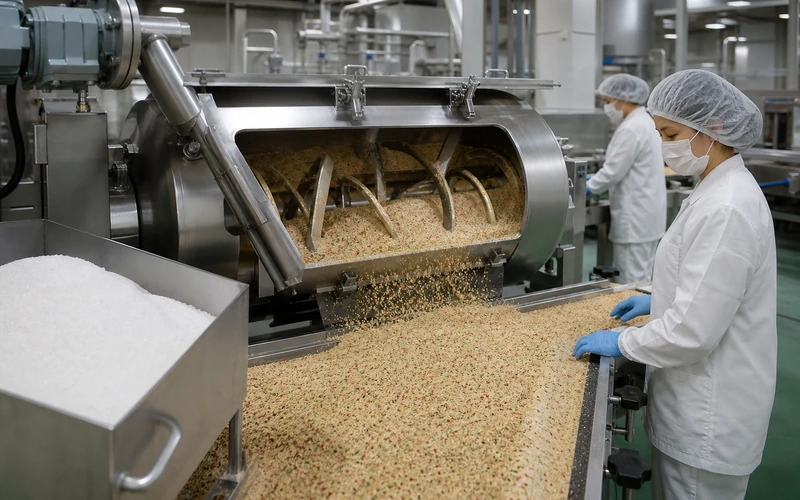
Matching sieve profiles is a useful first step. The blend still needs tests after mixing, transfer, and filling. Samples from the start, middle, and end of a filling run can reveal uneven mixing.
Balancing Saltiness, Bitterness, and Replacement Level
The share of KCl should suit both the sodium target and taste goals. KCl provides saltiness, but bitter or metallic notes may become clearer at higher levels. The response depends on the blend and its use.
For example, a trial blend could contain 75 kg NaCl and 25 kg pure KCl. This 100 kg blend has 25% less sodium than 100 kg pure NaCl. The example uses equal weights and assumes no other sodium sources. It does not prove taste acceptance or a valid label claim.
Trials should compare the blend with the reference salt in soups, cooked vegetables, and seasoning mixes. Ingredients added to balance taste also need food-use and label checks.
Testing Blend Uniformity and Storage Stability
The finished blend should stay even and flow well through its planned shelf life. Fresh samples alone cannot show whether transport or storage will cause separation or caking.
A trial can compare sodium or potassium levels across samples. It can also check flow after storage and taste over time. The study should use the planned pack and storage conditions. Pass limits should be set before the trial starts.
Food-Grade Standards and Labeling Requirements
Raw material approval and finished-product labeling need separate checks. The KCl grade must meet food-use rules. The finished blend must meet the rules for its formula, claims, and market.
FCC, JECFA, and Destination-Market Rules
FCC and JECFA provide specifications used to assess food ingredients. The purchase contract should name the standard and edition. It should also list any stricter customer limits.
In the United States, 21 CFR 184.1622 addresses potassium chloride. It cites an FCC specification and sets conditions based on current good manufacturing practice. In the EU, E508 must meet purity criteria and food additive rules. Allowed users need checking for the exact product category.
Meeting one standard does not prove approval in every market. Export review must cover the grade, additives, planned use, and local rules.
Ingredient Names and Sodium-Reduction Claims
The ingredient name must follow the target market’s rules. FDA issued final guidance in December 2020 on the name “potassium salt.” It states its intent to exercise enforcement discretion for this name on U.S. ingredient lists. The name is an alternative to “potassium chloride.” This guidance covers naming; each product still needs its own compliance review.
Sodium claims require a separate check. For most U.S. foods, a “reduced sodium” claim needs at least 25% less sodium than a suitable reference food. The comparison uses the reference amount set by the rules. The chosen reference food and label statements must also meet those rules.
The finished blend needs review against those rules. Cutting the amount of added NaCl alone does not prove the full label claim.
Potassium Content and Intended Consumers
Potassium content matters as well as sodium reduction. The formula and grade data should support the nutrient amounts on the label. Tests should confirm the finished product where required.
WHO’s 2025 recommendation on lower-sodium salt substitutes containing potassium is conditional. It applies to adults using table salt during cooking or eating. It excludes pregnant women and children. It also excludes people with kidney problems or other conditions that reduce potassium excretion. The guideline does not cover salt substitutes already present in manufactured foods.
Salt makers should define who the product is for. They should check local rules for nutrient labels, warnings, and product claims.
How to Qualify a Food-Grade Potassium Chloride Supplier
Supplier approval should link the agreed spec to a named plant and a clear supply route. The review should cover the grade, quality system, and checks for each delivery.
Batch COAs, Test Methods, and Acceptance Limits
A certificate of analysis, or COA, should identify the exact grade and batch. It should show the required limits, results, and methods. The test basis must be clear where it affects the review.
Typical values and a sample COA can support an initial review. These must stay separate from results for the delivered batch. Some tests may run at set intervals. The supplier should make clear which tests cover each batch and which follow a wider test plan.
Units must also match. For a mass-based concentration in a solid, 1 mg/kg equals 1 ppm. A result stated as “less than” a reporting limit should keep that wording during review.
Food Safety Certificates and Batch Traceability
Food safety certificates can support approval when they cover the right site and activity. For example, buyers can check an FSSC 22000 certificate in the scheme’s public register. Its valid status and scope matter.
Batch records should link the delivery to its producer and quality records. Customer documents may also include allergen statements, GMO statements, and halal or kosher certificates where required.
A valid system certificate supports the quality review. The KCl grade still needs to meet the agreed material spec.
Packaging, Storage Conditions, and Supply Consistency
Packaging should keep KCl dry and clean during storage and transport. Sealed packs with suitable liners, dry storage, and clear batch labels help protect the grade.
Buyers should confirm pack size, pallet layout, shelf life, and storage conditions for the grade. The supplier should report changes in source, particle size, or anti-caking treatment before supply.
Supply approval should also cover lead times and how changes are handled. A new grade needs its own review and, where needed, another blend trial.
FAQs About Potassium Chloride for Salt Substitutes
A purity value, a grade name, and a product claim show different things. Each needs a separate check when a salt substitute is developed.
Does Higher KCl Purity Mean Less Bitterness?
No. Higher purity does not remove the taste of KCl itself. Taste also depends on the KCl level, particle properties, and food. A high assay helps control ingredient content. Taste trials show whether people accept the blend.
Can Pharmaceutical-Grade KCl Be Used in Salt Substitutes?
It may be suitable if the exact grade also meets the rules for its planned food use. The pharmaceutical grade name alone does not prove that. Food-use, additive, pack, and label rules still need checking against the supplier’s records.
Can KCl-Based Salt Substitutes Be Iodized?
Yes, with a tested formula that meets the market’s rules. Sodium reduction and salt iodization are compatible public health goals. Makers need to check the iodine compound, dose, and mixing process. Tests should also assess iodine loss during storage. The blend should meet its stated iodine level through its planned shelf life.
Conclusion: Selecting the Right Food-Grade Potassium Chloride
The right food-grade potassium chloride meets purity and safety limits and works well in the finished blend. Buyers should link grade data with mixing trials, taste checks, storage tests, and label review. Clear batch records help keep quality stable during routine supply.
Manufacturers assessing chemical grades and supply options can contact SUMEC Chemical. The inquiry should state the target market, required specification, and order volume. Food-use suitability and supporting records need checking for the exact proposed grade before purchase.tandee